Tell me, what else should I have done? Doesn't everything die at last, and too soon? Tell me, what is it you plan to do with your one wild and precious life? —Mary Oliver
I’ve learned that holding tightly to one’s sense of wonder and joy is a form of resistance to the negative forces in the world, so I decided I would pay closer attention to the beauty and delight that surround me. I will stand up and fight back by finding ways to enjoy the ordinary pleasures and gifts that are worth fighting for and that give us the motivation to join the fray.
We need Joy as we need air. We need Love as we need water. We need each other as we need the earth we share. Maya Angelou
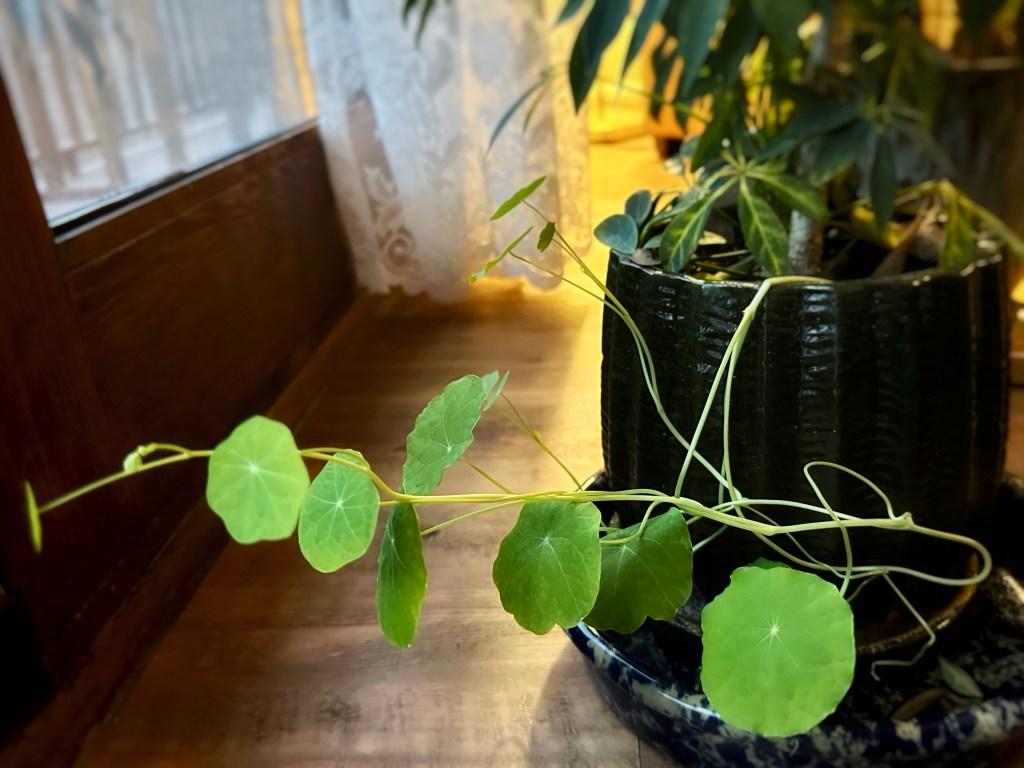
I am not a plant person. I like plants, but let’s face it, I’m not that great at keeping them alive. I’ve admitted my inadequacy to myself, and I’ve told the leafy ones that share their lives with me that sometimes they are just going to have to fend for themselves. I know…tough love. At present, I have two Schefflera plants that my sister gave me from slips of plants that were given to our family after the death of each of our parents. Last summer, I set the two plants out on the deck so they could bask in the sunlight and enjoy the deliciously warm, rain. Near the end of the season, I brought them back inside, where they continued to create new leaves and stretch for the ceiling. A few weeks ago, much to my delight and surprise, I noticed another plant growing in one of the pots. It seems that while they were lodging beneath the planter boxes on the deck railing, a seed from one of the nasturtiums had fallen into the pot. After months of lying dormant, the wee seed had taken root and emerged into the light. I was overjoyed.
The fragile stems direct the leaves toward the light. Montpelier, April 2025
Joy bursts in our lives when we go about doing the good at hand and not trying to manipulate things and times to achieve joy. C.S. Lewis
The unexpected discovery of this tiny new life bursting forth from a single seed determined to live even in the unfamiliar soil of a shared pot brought me great joy and was wonderfully life-affirming. Often, that is how joy manifests itself in the simple, the mundane, and the overlooked. If we allow it, the joy will come, and yet these moments of pure bliss are often fragile and ephemeral. Like a soap bubble whose iridescence disappears in the sun, joy cannot be bound or held forever. We must glory in its wonder while we can.
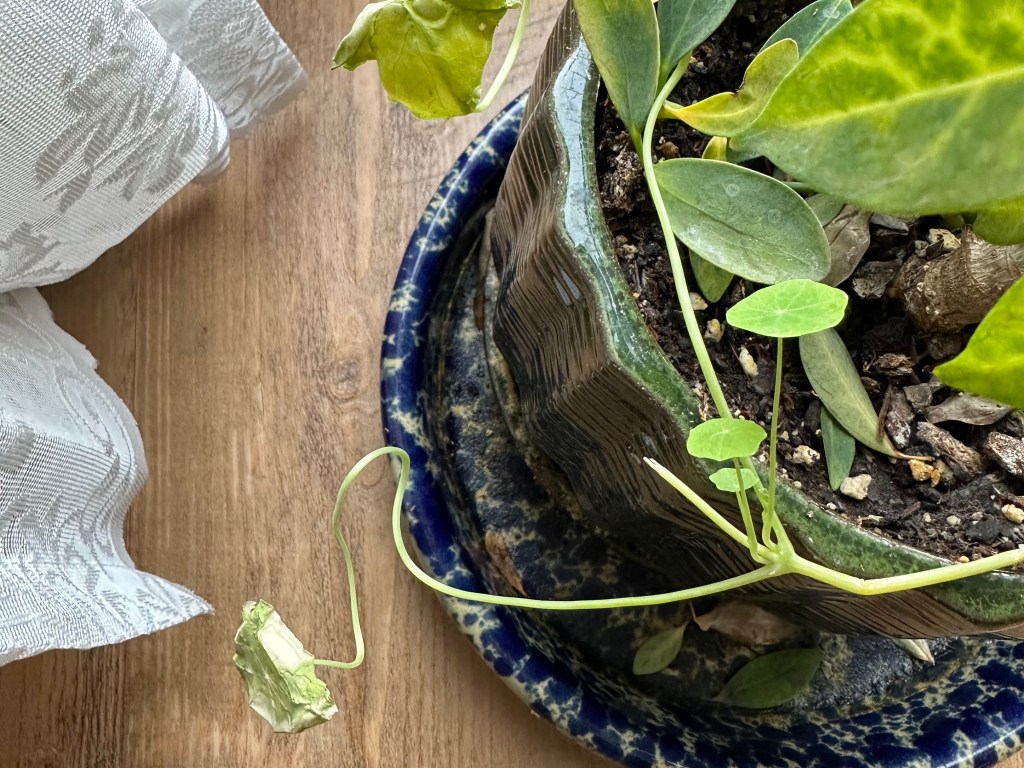
Not long after making the discovery of my tiny green friend, I awoke one morning to a painful discovery. During the night, Effie, my automatic vacuum cleaner, had gotten tangled in the tender stems, and only two small leaves were still hanging on. My joy had quickly turned to despair; a reminder that often that which brings us joy must be nurtured, protected, and encouraged whenever possible. The Psalmist tells us that ‘weeping may endure for a night, but joy comes in the morning.’ Happiness and sorrow, as I have learned, are simply opposite sides of the same coin and often come hand in hand. Joy will come in the morning, but the night may return with pain and weeping.
Having spent most of my life in the company of children, I’ve been privileged on many occasions to witness the loss of a tooth. At first, the child worries the tooth with their tongue, playfully working at it as it loosens. Tiny fingers then begin to wiggle, wiggle, wiggle that tooth. Forget math and reading, at that moment, life is all about the loose tooth.
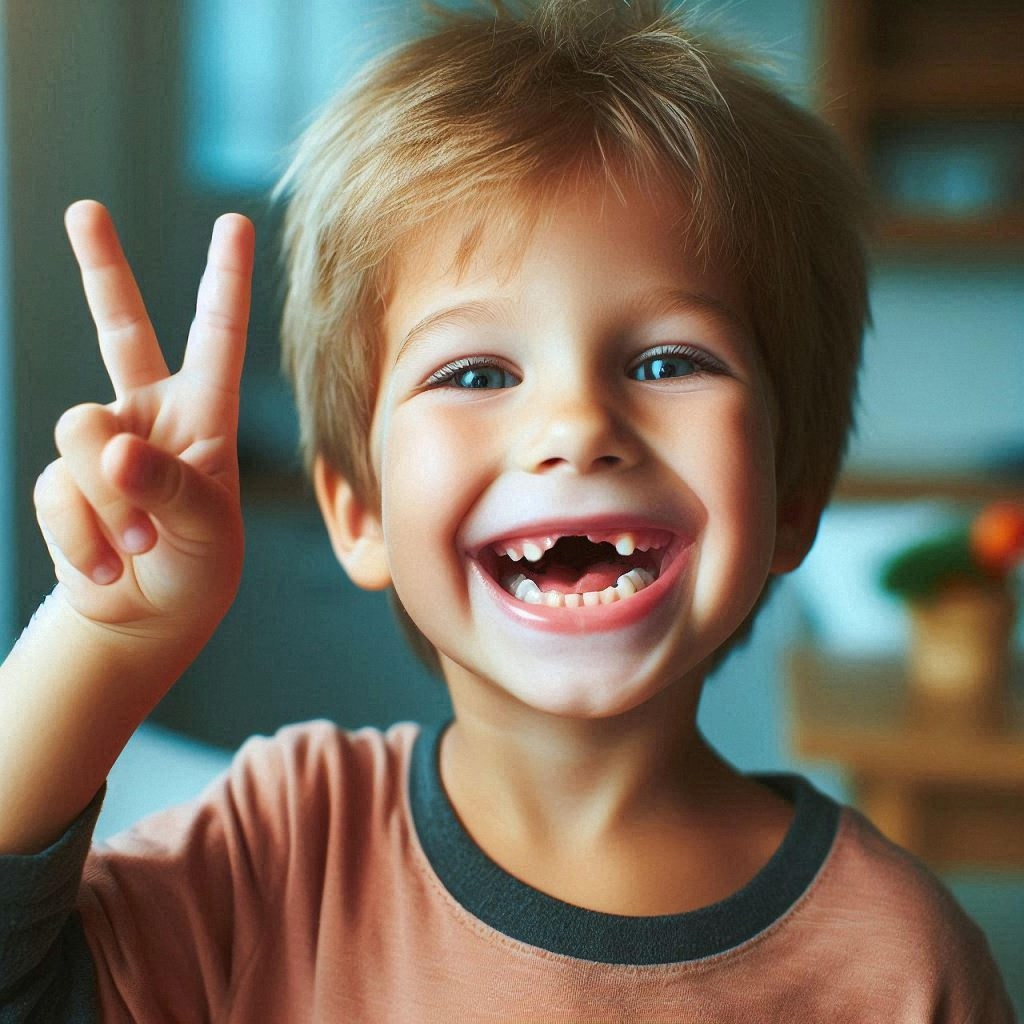
The most difficult and most painful part of this adventure comes next. The child, the waiting fairy, and the tooth itself all want the tooth out, but fear and the anticipated pain of removing it result in hesitation and require decisions. Should they use one of the various string-around-the-tooth methods or just reach up and yank that baby outta there? Regardless of the method decided upon for the extraction, the result is almost always the same. Fear and trepidation distort the child’s face, usually accompanied by a few tears. Pulling a tooth, especially the first few, isn’t easy. The child wants to do it, but doubts that they can until ultimately they do. Triumph! With the tooth out, the facial expression changes immediately into one of amazement and delight. The bloody tooth held tightly in tiny fingers is presented with more pride, satisfaction, and euphoria than a World Series trophy, a Super Bowl ring, or the Masters green jacket. It is pure, unadulterated joy.
Unadulterated JOY Image: Pixabay AI
Joy may change its form, but it will return. Two days ago, I noticed a very tiny shoot with three infant leaves coming from what remained of the original plant. With determination and tenacity, it was holding on to life and sending out tiny, delicate green leaves. Joy! Joy! Joy! My heart with joy was ringing! Elation!
Death and New Growth Together in One Plant Montpelier, April 2025
“Joy does not simply happen to us. We have to choose joy and keep choosing it every day.” — Henri J.M. Nouwen
I often ruminate on the idea of Joy. I know that it’s often unexpected and fragile, and I know that if I wait patiently I will find it again. I need to recognize it, nurture it, and appreciate it for what it is. Joy, like love, demands that we be open, vulnerable, and brave. Just like pulling that tooth…there may be moments of fear, apprehension, and unease before reaching the ultimate joy.
Even on the darkest days somewhere a candle flickers. Its dancing flame courageously fighting to hold on to the mystery of its burning. Recognizing joy and wonder, nurturing it in our memories, and holding it tightly in our hearts becomes the light we bring to the darkness giving us the courage to carry on.
I do not enjoy suspense. I like books and movies where you know right from the start that the hero makes it to the other side safely, happily, and in one piece. And, in all honesty, I also like to know up front if the main character will die before the final scene. So, in case you’re that kind of person too, I’m giving you a heads-up…the main character, the heroine of this tale, my mother, dies in the end. It is not a story of sadness and sorrow, although they unavoidably play a part. No, the tone of this story was set by the leading lady. My mother approached her death with acceptance, courage, curiosity, and humor.
“I think this will be a great adventure,” she said. Then she added, “I’ve never died before. I don’t know what it will be like.” The way she chose to face this final chapter was her last and perhaps most important lesson and one of her greatest gifts.
Mom
I had slipped into her room while she was sleeping, so Mom didn’t know I was sitting quietly in the corner when her doctor entered and wiggled her toe to wake her.
“I want to check out,” she said.
“Oh, I can see to that. I’ll get the paperwork ready. Then, if you wish, you can go home as soon as that’s finished.”
“No,” she explained. Then, with her palm parallel to the floor in a sort of horizontal karate chop, she gestured from her body toward him, emphasizing the words, “No, I want to…check…out. I don’t want any more treatments. I just want to go home.”
Immediately, an enormous unbidden lump rose in my throat. I couldn’t imagine life without my mother, but I understood her decision. She had been dealing with one medical complication and setback after another for years. She was stoic and cheerful for the most part, although she was often in pain. Her zest for living and her ability to make new friends wherever she went hid her daily discomfort.Even on that snowy January morning, her spirit wasn’t broken, and her love of life remained ever present, but the last challenge she had endured just two days earlier and the diagnosis of congestive heart failure that followed changed things. Sometime during the night, she decided that she simply wished to live out her remaining days in the comfort of her home without any additional medical interventions besides those required to keep her comfortable and free from pain. She had played the hand dealt to her skillfully, but now she was ready to leave her cards on the table and head for the door.
“You know,” she concluded, “I think 90-plus years is enough.”
While arrangements were made for her to be transported back to her assisted living apartment, I called my sister, who would meet us there. Then we let our other siblings and our spouses know of this development. Just like that…filled with emotion and the sudden perception of being untethered and carried along willy-nilly by the fickle and unpredictable direction of the wind…together with Mom, we began the last great adventure of her life.
Of course, Mom would be the only one boarding the train in the end, but we’d do whatever we could to help her prepare for the journey. We would pack her bags, make sure she had her ticket, and when the train pulled into the station, we’d help her up the steps as she climbed aboard. Then we would lean against each other as we stood on the platform, watching it pull away, leaving us behind as she ventured on without us.
As a teenager in the mid-late 1960s, I attended Lake Louise United Methodist camp near Boyne Falls, Michigan. One evening, during a vesper service with the lake before us, the sun setting in the distance and flames of the campfire dancing into the approaching night, one of the adult leaders shared a message that has stayed with me through the decades. I’m unsure what prompted his reflection, but part of this homily left a lasting impression.
“It’s true,” he declared, “that you only have one life to live. So live it well. It’s also just as true that you only have one death to die, so don’t waste it, make it count, and do it well.”
Nothing else from that evening remains. There were probably verses of Kum Ba Yah and a prayer or two thrown in, but those words about dying well took up lodging in my brain… don’t waste it; make it count, and do it well. Of course, we aren’t all given the opportunity to put these admonitions into practice; perhaps few of us are. The time and manner of our departure are usually a matter of fate coming without warning rather than at a time and place of our own choosing, but it is truly a gift of grace when we can face our imminent departure, determined to do it well.
Mom thought that by simply deciding to die, it would be just a matter of days until…in her words…she flat-lined; however, that wasn’t how things worked out. No, dying wouldn’t be quite that easy. Instead, like once brilliant sidewalk chalk drawings on a rainy afternoon, she would slowly slip away. Observing this process wasn’t easy, but I am forever grateful for that brief gift of time.
Two years earlier, when Mom moved from her condo to her apartment in the assisted living facility, the task of emptying and selling her house fell to her children. It was difficult for her to know that the possessions, treasures, and minutia of her life were being sorted, divided, and disposed of without her supervision. One day during this process, she asked, “Do you know what happened to that little wooden box I kept on the marble-topped stand? Do you know the one I mean?”
“The box that was carved and had inlaid ivory on the top? I queried.”Lined with blue velvet? Is that the one you mean? I gave you that box for Christmas when I was in High School. I bought it at the Grand Rapids Museum. I don’t know where it is now, though.”
“Well, it’s probably right there on the stand.”
I didn’t have the heart to tell her that my brother, who had been promised this piece of furniture, had already taken it to his house.
“What made you think about that box, Mom?” I asked.”
“Well,” she said with just a slight hesitation, “It has my thumb in it.
Decades previously, while working on one of her many projects, Mom had cut off her thumb at the joint with a table saw. She was home alone at the time, and although she searched for her thumb, the force of the blade had flung it out of sight. Finally, giving up her search and bleeding profusely, she wrapped a towel around her hand and drove herself to the hospital. Thinking that perhaps the neighbor’s cat had found the wayward digit, Dad was surprised when, months later, he discovered the desiccated thumb in the woodpile. Evidently, unbeknownst to me, Mom had kept her thumb in the ornate wooden box.
“I’ll keep an eye out for that box, but I bet you brought it here, and you’ve just forgotten where you put it.”
Now, with the end of her journey in sight, her attitude to the sorting and redistribution of her things suddenly changed. She was no longer interested in who had what or what became of which. Shortly after returning to her apartment from the hospital, she directed us to do whatever was needed to dispose of her remaining possessions. Since she was now confined to her bed, we tried to make the process less difficult for her by working outside her line of sight. I reminded her of how painful it had been disposing of her things earlier.
“Well, I don’t feel like that now. No, I want you to work on emptying this place. Then, if I die before the end of the month, you can be out of here without paying another month’s rent.” Everyone thinks their mother is unique, but mine was an original…truly one of a kind.
During those precious days, my siblings and I were each granted time alone… one-on-one time…private time…personal time…with Mom. Since I wasn’t working, I was able to spend quantity time as well as quality time with her. We reminisced and laughed as she shared memories and oft-told tales…teaching my aunt…famous for her infectious laugh…how to drive, and the night she delivered her grandson when he arrived before I could make it to the hospital. I listened, too, while she recalled deep hurts from years long past that still haunted her and the disappointment that she felt knowing that there were still things on her to-do list that wouldn’t get checked off. We also discussed the memorial service she expected me to lead. “It would be nice if there were a few tears,” she admitted, “but I really hope the memorial will be a joyful celebration of the wonderful life I’ve had.” We were all blessed by the gift of time, but eventually, as we knew she would, she began to slip away.
Wolf Neck, Maine
Her Last Adventure…Part Two
In time, Mom began to sleep more, speaking infrequently, with many hours between verbal interactions.
When I was young, my paternal grandparents lived across the street from an old cemetery. Without television or much else to amuse us, my brother, my cousins, and I would entertain ourselves by wandering the garden of stones, reading epitaphs and last words chiseled into the sandstone and slate, so when Mom did speak, I was careful to mark her words, just in case they were her last.
“One afternoon, one of the caregivers from her assisted living facility came in and sat at her bedside. Mom was one of the favorites, so it wasn’t uncommon for them to join us. In gentle tones, she spoke quietly to Mom, who hadn’t been responsive for a long time. As she rose to leave, Mom said softly, “I love you.” How wonderful, I thought, if her final words were, I love you. Mom would end most conversations with “Know I love you,” which would also appear at the end of written conversations as KILY. How appropriate that she would leave us with words of love.
“If we’d been in a Hallmark movie, those would have been her final words, but..real life isn’t scripted. One morning, a few days later, I assisted a hospice volunteer as she gave Mom a sponge bath. The attendant was kind and caring, but Mom had cried out several times in pain. It was upsetting and traumatic for all three of us. On her subsequent visit, the volunteer spoke soothingly, explaining what she would do.
“Jean, I will help you bathe and do my best to keep you pain-free. If you disagree, you can just tell me to shut up.”
Suddenly, after an extended period of silence, Mom said, in a solid, clear voice, ” Shut up!” Oh! No! Her last words would be shut up!
There was no sponge bath that day.
Luckily, however, those weren’t destined to be her final comments. One evening, a hospice worker we hadn’t met before arrived to check in on Mom and to see how we were holding up.
“Hello, Jean. My name is Alex.”
Before he could continue, our mother, who hadn’t spoken or indicated that she was aware of our presence in what seemed like days, interrupted. “Oh, Alex. Alex.”
“Mom, this is a different, Alex, not the one you know,” my sister interjected. Then, turning to Alex, she continued, “Alex, my mother would want you to know that this is not how she planned her demise. Her plan was to die in her own home, in her own bed…,” and before Kelly could finish, Mom interrupted again with the words that would indeed prove to be her last.
“…making love to a much younger man.”
Oh, Perfect! True to form, Mom left us with a reminder of her humor and her joie de vivre. The moment was complete and even more poignant when Alex leaned over and kissed her tenderly on the cheek. Truly perfect.
Shenandoah National Park
The hospice nurse advised us that we were probably entering the final hours.
Penny, Kelly, and I summoned our brother; our spouses had returned home to wait; the caregivers no longer joined us in singing at her bedside as we had often done; the hospice volunteers sat unobtrusively down the hall, and with her four children gathered around, Mom’s journey…her final adventure was nearing the end.
Throughout the day, as she slept, we continued to clean cupboards and prepare the apartment in anticipation of her departure.
“Hey, Kerry, would you like this box of arrowheads?” I asked, offering my brother the collection we had discovered in a closet.
“Sure,” he replied. Then, as his smiling sisters extended the lovely wooden box with an inlaid ivory lid, he recoiled suddenly. “Wait a minute! Is Mom’s thumb in here?”
Impishly we replied in near unison, “Yep, and now it’s yours.” Gee, I hope Mom heard that!
As the day became evening became night, we found ourselves all sitting around the bed. We were on holy ground, sharing a sacred, intimate, profoundly spiritual moment. In this prayerful attitude, we passed the last carton of her favorite Breyers Strawberry Ice Cream between us. “We’re finishing the last of the ice cream for you, Mom,” my sister said as we shared this impromptu ritual of an ice cream communion.
One of the most disturbing, soul-crushing cinematic scenes in all of moviedom is the death of Bambi’s mother. “Your mother can’t be with you anymore. Man has taken her away. Now you must learn to be brave and learn to walk alone.” For most Baby Boomers, it was the first time we realized that our parents could and eventually would leave us. Unlike Bambi, however, I was not alone in the forest as I had feared all my life. When she took her final breaths, we were holding her hand or touching her arm, creating a chain that linked us to her, each other, and the untold number of people she had affected throughout her long life.
Early in the morning of January 25th, 2018, my mother, Jean Ethel Trueman Daab, with all her earthly tasks completed…a life well lived and a death full of grace, gratitude, and wonder… boarded the train and took her leave.
I miss my mother every day, and I often think back on this profound experience. I am so grateful for her example and her constant reminder to “celebrate being alive. Thanks, Mom! Know I love you…Always.


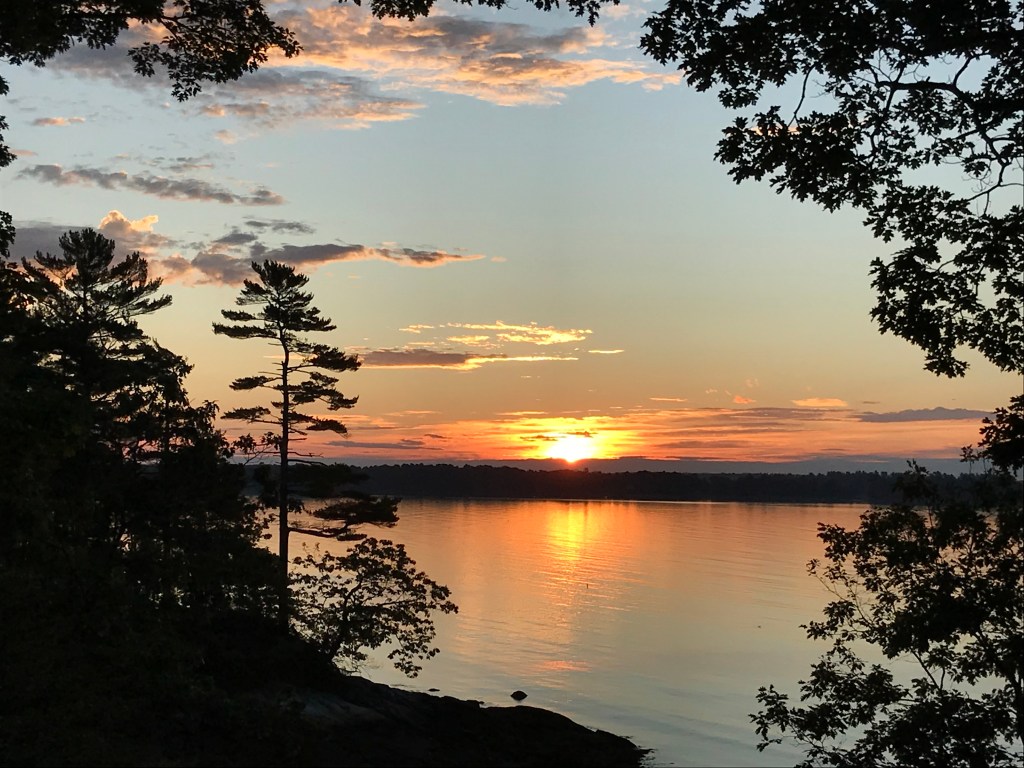


 One Wild and Precious Life