Lessons in Reclaiming, Reframing and Redemption from a Pair of Earrings

I don’t remember rising from my chair or crossing the room. My eyes burned, and a considerable lump was forming in my throat. I avoided eye contact and moved forward as though wearing blinders. I concentrated only on the singular mission of reaching the double glass doors on the far side of the room. I needed to reach those doors and escape before the hot tears I’d held back breached the dam and burst forth uncontrollably.

At last, I felt the cool metal of the door handle beneath my palms. Pushing down, I released the latch. Leaving the conference room behind, alone on the sidewalk, the pain and humiliation suddenly burst forth in the tears and sobs I’d been suppressing. Needing to put the experience behind me, I began walking without regard to direction or destination.

Ironically, the conference theme was welcoming and inclusion. We listened to speakers, participated in activities, and discussed the topic at length. Then, early in the afternoon, one of the facilitators began speaking about an upcoming project. Nearing the end of her talk, she asked those qualified to stand and create a circle around the tables and chairs. Then, she asked another category of participants to join them in the circle. The circle grew more extensive with each new set as the number of those who didn’t meet any criteria dwindled. This continued until only five of us remained seated, excluded from the circle of over one hundred others. Because they were standing, they looked down upon us literally and perhaps figuratively as well. Someone in the circle shouted, “What about those still seated? Can’t they join the circle?” but the unknown speaker was ignored or unheard. I was embarrassed by the situation, but within moments, it became worse.

“Now,” said the leader, “Look around the room at the people standing in the circle. These are your peeps. These are the people who are going to be moving forward with you.” I felt invisible and, paradoxically, as if all eyes were on me. I knew it was without malice; nevertheless, I felt singled out and alone. With downcast eyes, not looking at the others seated inside the circle with me, I longed for one of Harry Potter’s disapparating spells. I couldn’t wait to escape that circle and that room!


After the initial flood of tears, I collected myself and continued walking. It wasn’t the first, nor would it be the last time I’d ever be embarrassed; however, in this instance, it was totally unexpected and beyond my control. The conference leaders had utterly missed the workshop’s message and the opportunity to model a way to include everyone. I hadn’t signed on to experience being in the empty set, but I was undoubtedly discovering how it felt.


It was a warm fall afternoon, but l was numb. I paid little attention to the sun, the color of the leaves, or the people I passed along the way. However, several blocks later, when I found myself in front of a small shop exhibiting the work of local artisans, I decided to stop and explore.

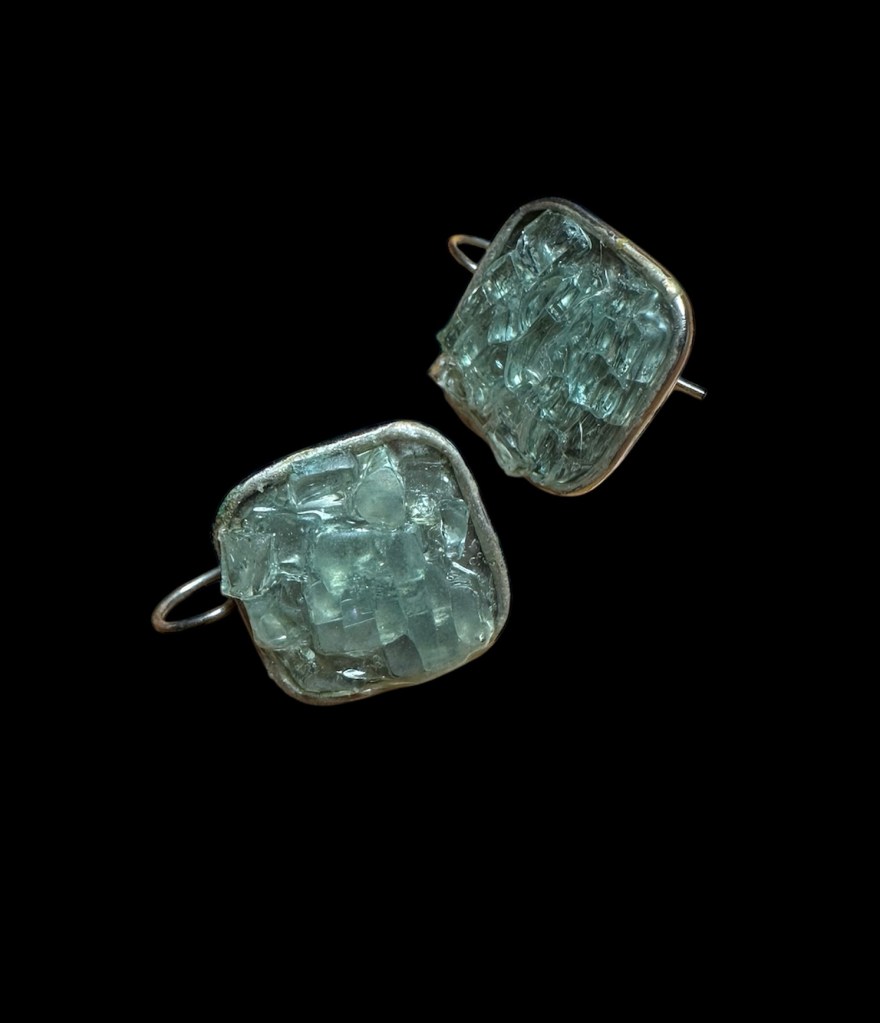
It was a nice break from the intense emotions I’d been experiencing. Still, nothing interested me except for a small display of jewelry directly under the beam of one of the limited overhead lights, compelling me to stop and look. Each piece, earrings, necklace, or ring, was made from small chips of an indeterminate material. The soothing green color was reminiscent of lichen-covered rocks I’d seen near the shore of a frozen lake or perhaps more like translucent sea glass.

It was calming and beautiful. I was drawn to the display as if being pulled toward it by an invisible string. I inspected several pieces, turning them over in my hands, holding them to the light, and admiring the pleasing shapes. Ultimately, I noticed a small handwritten message from the artist explaining her work and choice of medium.

She returned to her parked car one afternoon to discover that the windows had been smashed and the interior had been gutted. Thick shards of broken glass lay on the ground surrounding the vehicle, and what appeared to be a million tiny pieces covered the seats inside. She felt violated and was full of rage. She scooped up the bits of broken glass and took them to her studio.

Most of the artist’s story was left to the imagination. She didn’t explain her thought process or how long it took to consciously reclaim the situation and find a way to transmute her negative feelings into something positive and beautiful. The important thing is she did. Could I do the same? Could I find a way to channel my emotions into something positive and good? Could I reclaim my situation?


I bought a pair of earrings, fitted them in my ears, and turned back toward the conference.

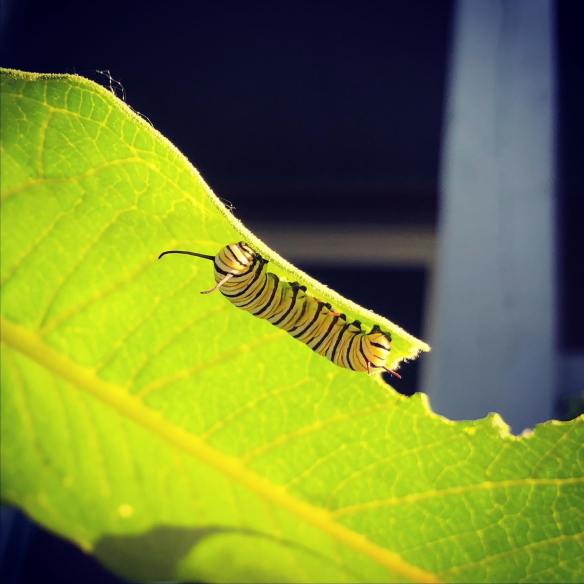
It takes courage to find forgiveness, beauty, and grace when confronted with disappointment, negativity, and pain. It also requires a desire—or, as my mother used to say, a want to—to seek the good and imagine a way for the caterpillar to emerge as the butterfly.

Upon my return home, I wrote a long letter to the conference committee about my experience and how it might have been handled differently. Sharing my observations changed things—all for the good. I paid the tuition, but others learned lessons from my experience, making life easier for those who came after me. I have always felt that a force outside myself led me to those earrings and the lessons they continue to teach. I feel powerful whenever I wear them, for they remind me that even an adverse situation can lead to something unexpected and positive.


I’m entering 2025 with trepidation and uncertainty. This is not the future I hoped for or envisioned. And yet, those earrings remind me that even a broken windshield can become beautiful if we’re willing to collect the shards. Transformation and resistance take determination, patience, resilience, and sometimes strong glue. Life will always be complicated and challenging, so I suggest we also have plenty of emergency chocolate standing by.
Life in The Chrysalis

We delight in the beauty of the butterfly, but rarely admit the changes it has gone through to achieve that beauty.

Maya Angelou

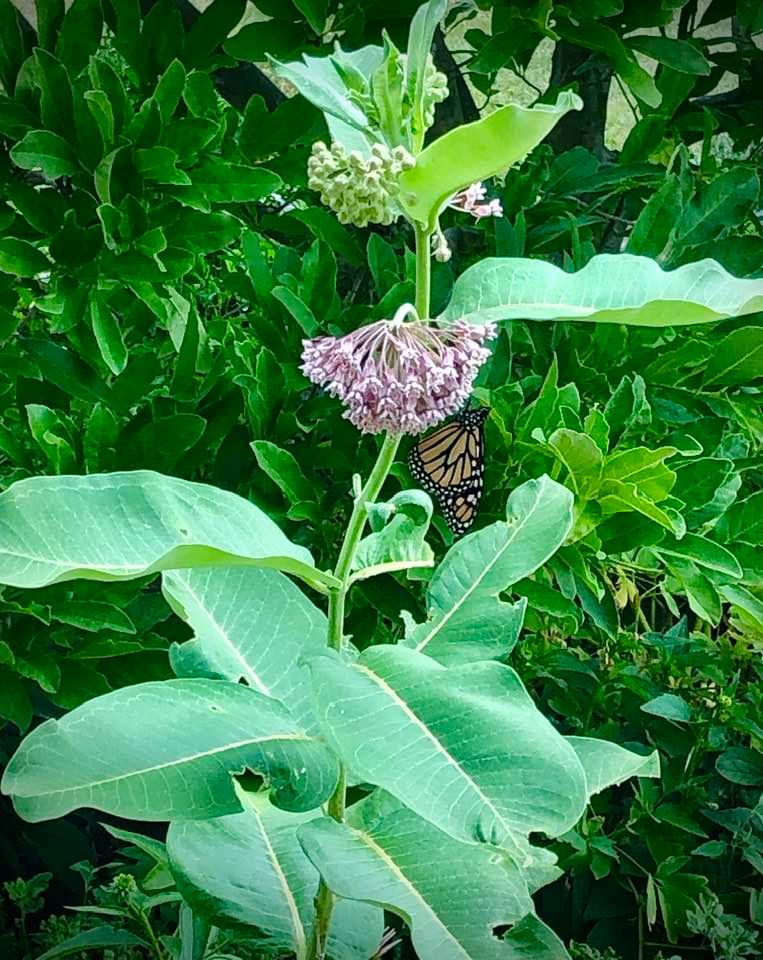
Tucked in amid the profusion of perennials that surround my sister’s house you will find a huge milkweed plant. Often relegated to roadside ditches or borders along the back-forty, milkweed is dwindling in number along with the Monarch butterflies who spend their caterpillar phase living and feasting on the host plant’s bright green leaves.  This particular milkweed did not suddenly appear in my sister Kelly’s garden unbidden and unannounced. It was planted and nurtured there with intention; an invitation to passing Monarchs looking for a place to lay their eggs. “Please, come. Land here. We want you in our neighborhood.” The hardy plant grew tall and strong, full of broad leaves, but not a single Monarch flew by to check out the menu or the accommodations.

Finally…a couple weeks ago, my sister, called to say that she had discovered a Monarch caterpillar feasting on the milkweed. “Come on out. You’ve got to see it,” she implored with great excitement. “It’s amazing.” So, with my mask in place and observing social distancing, I  went to watch this remarkable little fella sprint from the bottom of the stalk up toward the buds of the blossom at the top.  He was a voracious eater and quite the little gymnast.

The First to Arrive (Photo: Kelly Daab Green)

Then, just as suddenly as he appeared he was gone.  Apparently, Monarch caterpillars are considered a delicacy by the Orioles who nest nearby. Kelly was heartbroken as she imagined her little friend being the main course at an Oriole summer picnic. Perhaps, however,  her striped buddy had escaped the birds and traveled to find a more safe and secure place to construct his chrysalis. Monarchs will often hike as far as ten meters in search of the perfect spot, but whatever his fate…lunch or location…he was no longer present on her milkweed.

In the coming days, she searched the remaining leaves, waiting and willing another caterpillar to appear on her special plant, vowing that if she found other she’d bring it in and rear it, keeping it safe from predators. No one came.

Imagine her joy when days later, while exploring the back fields near her rural home, providence placed her right next to another milkweed where a beautiful orange and black queen of the sky rested quietly on a leaf. As she watched, the regal butterfly appeared to shudder slightly, pause and then fly quickly away leaving behind a very tiny, cream-colored egg. Once she knew where to look and what to look for, Kelly found many more of these pearl-like spheres no larger than the head of a pin.

Led by Providence (Photo: Kelly Daab Green)

Originally, Kelly had hoped to watch a single caterpillar progress from larva to pupa and then butterfly; instead, my little sister was rapidly becoming a Militant Monarch Mama caring for her tiny charges as they grew, and she learned more about how to nurture, protect, and defend her growing army of caterpillars.

Humans have always been drawn to butterflies. It is mesmerizing to watch one of the delicate, winged creatures flit from flower to flower, gathering nectar, knowing that our momentary pleasure will end too soon as they hurry off toward the next stop on some ancient instinctual travel plan. The way butterflies float and drift on the currents, alighting momentarily just beyond reach, is magical. Our eyes trace their carefree journey across the sky, and we marvel that such fragile wings can carry them about the clouds.

On the Migratory Path, Vinalhaven, Maine, October 2019

Of course, there are many dangers and obstacles that threaten our wee friends…lack of habitat, climate change, rain, dust, pesticides, and birds… but these flying Buddhists don’t worry about such things and are not troubled by thoughts of the future. Always living in the present moment, their short lives are unencumbered by responsibilities and are filled with beauty and freedom.

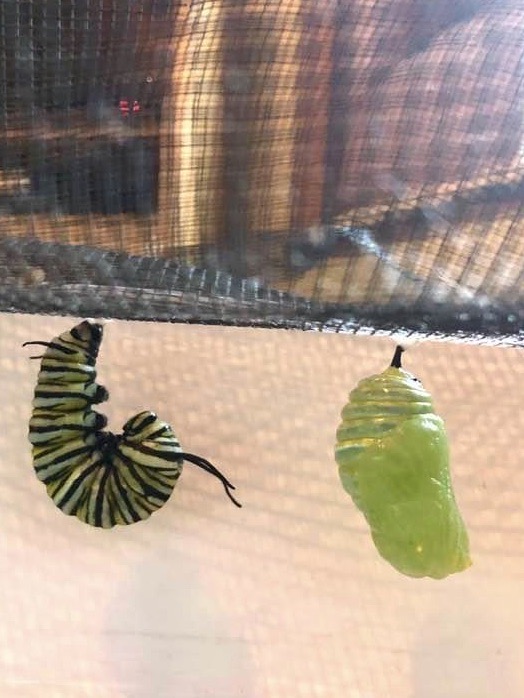
One early evening a few nights later, I heard the ding on my phone alerting me that I had a message. I was delighted to receive an update complete with photos. There on the screen was a close-up of a small, silky, green chrysalises and a buddy about to create one of his own. Two of Kelly’s charges were one step closer to becoming butterflies.

Caterpillar to Chrysalis (Photo: Kelly Daab Green)

Watching a lowly caterpillar snake off his jester’s garb and shimmy into a silky green changing booth only to emerge dressed in the bright orange raiment of a sovereign, it’s easy to understand why butterflies often symbolize the soul, transformation, or rebirth. Their metamorphosis is the epitome of second chances and new beginnings.

While there are many references to caterpillars and butterflies, when discussing change and transition, I find little mention of the chrysalis or the time spent within it. What’s going on in there? How does a caterpillar grow wings? Biologists have studied the changes that occur within this hidden realm, but to the casual observer…people like me…it remains mysterious and miraculous.

I wonder if the caterpillar was surprised to find that it was slowly twisting and turning itself into the strange vessel that was to be its new home. Does he have an idea of how long he’ll be hanging there or why or what he’s supposed to be doing? Does he know that he is in the world, yet secluded from it?

No. Probably not.

“The caterpillar does not become a butterfly by telling everybody it has wings. It actually buries itself in darkness and grows those wings.”

C. JoyBell C.

Lately, I have had the feeling that I, too, am living in a kind of chrysalis…isolated, waiting, expecting, and hoping for change.  How long will this last? Will I emerge better and stronger? Will I find wings with which to fly? Will my former life on the milkweed be recognizable when I reemerge into a post-COVID-19 world? Some things, when they change, never do return to the way they once were, and butterflies reassure us that that can be a good thing.

“When you find yourself cocooned in isolation and you cannot find your way out of darkness…Remember, this is similar to the place where caterpillars go to grow their wings.”

Nicole Stephens

And so…we wait.

We hope.

We remind ourselves that even life inside a chrysalis is a gift.

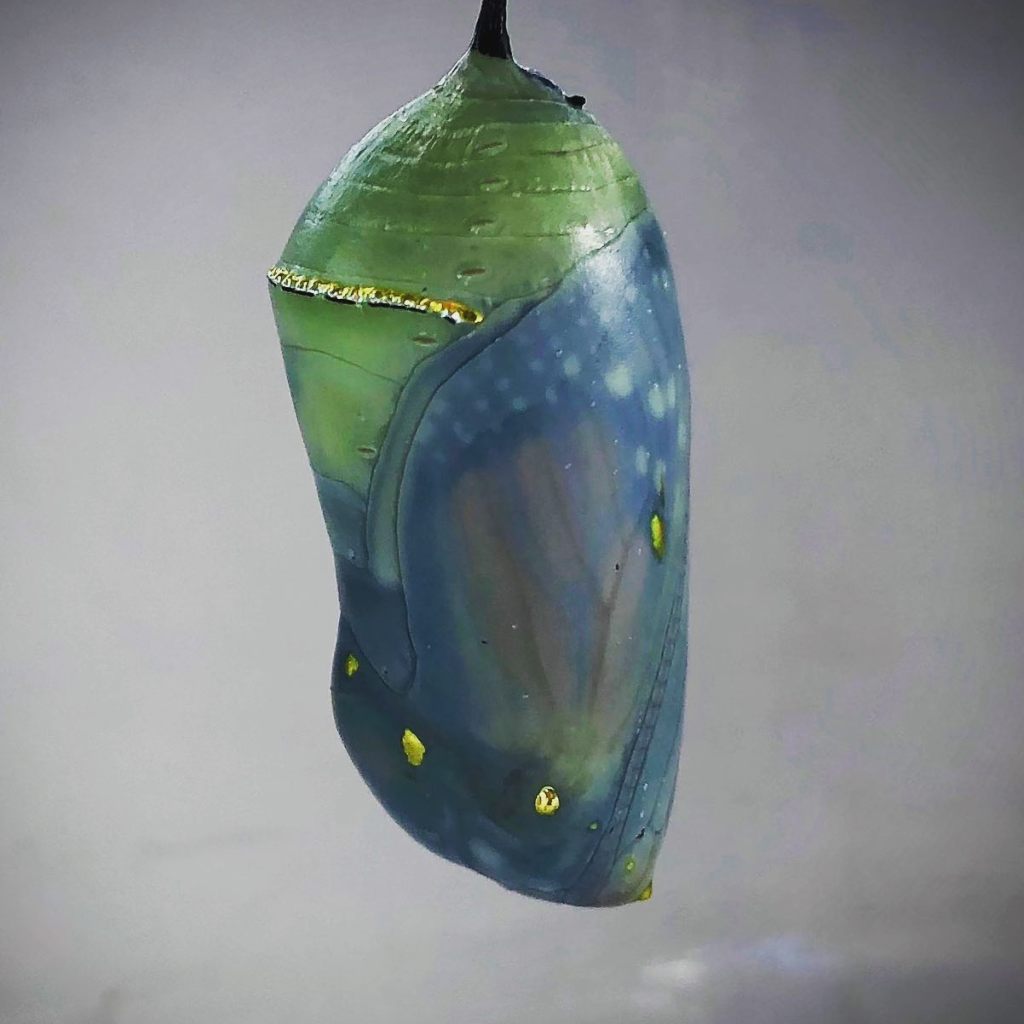
A few days after the first two chrysalises appeared, Kelly sent me another text message with yet another picture of her two charges. I had no idea that with time a small, silky, green chrysalis would become so amazingly beautiful.

Gold and Jewel Tones (Photo: Kelly Daab Green)

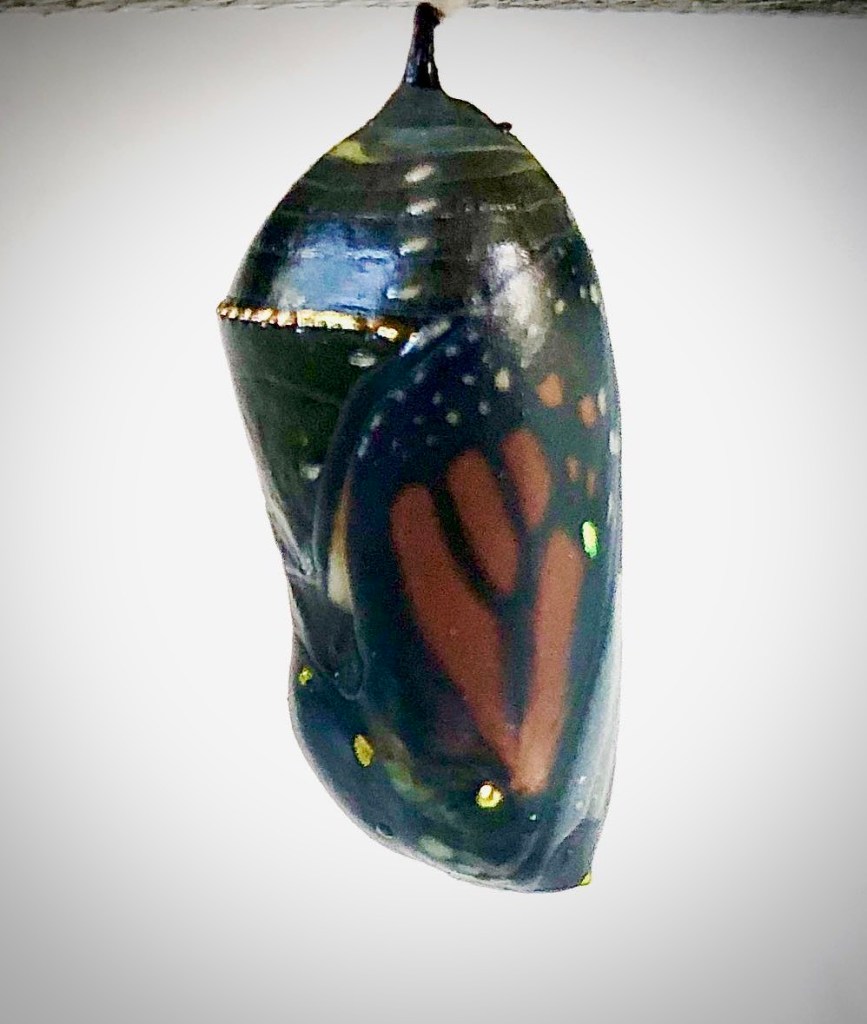
And…it would continue to change before the butterfly would break free and unfold its wings.

Almost Time to Break Free (Photo: Kelly Daab Green)

Like butterflies, we have the power to modify our own chrysalises. Yes, it’s true we’re still confined by limitations, but it is amazing the many ways we are finding to bring beauty, connection, and joy into our lives? We attend family gatherings over Zoom; we live stream theatre and comedy shows; we create virtual choirs; we visit friends at a distance of at least six feet; we spend time outdoors; and we use our eyes to smile at strangers over our masks.

Not all chrysalis hatch, you know. Sometimes they are destroyed or eaten or just don’t make it. Nothing is guaranteed. Let’s not wait for our wings. Our life is now.

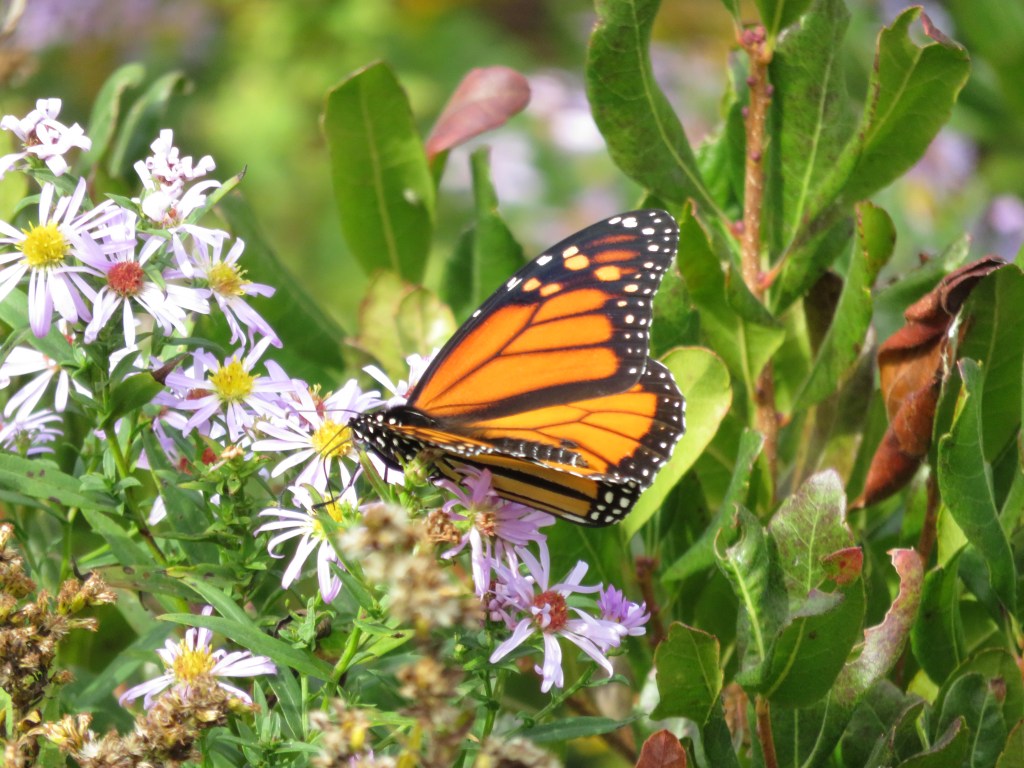
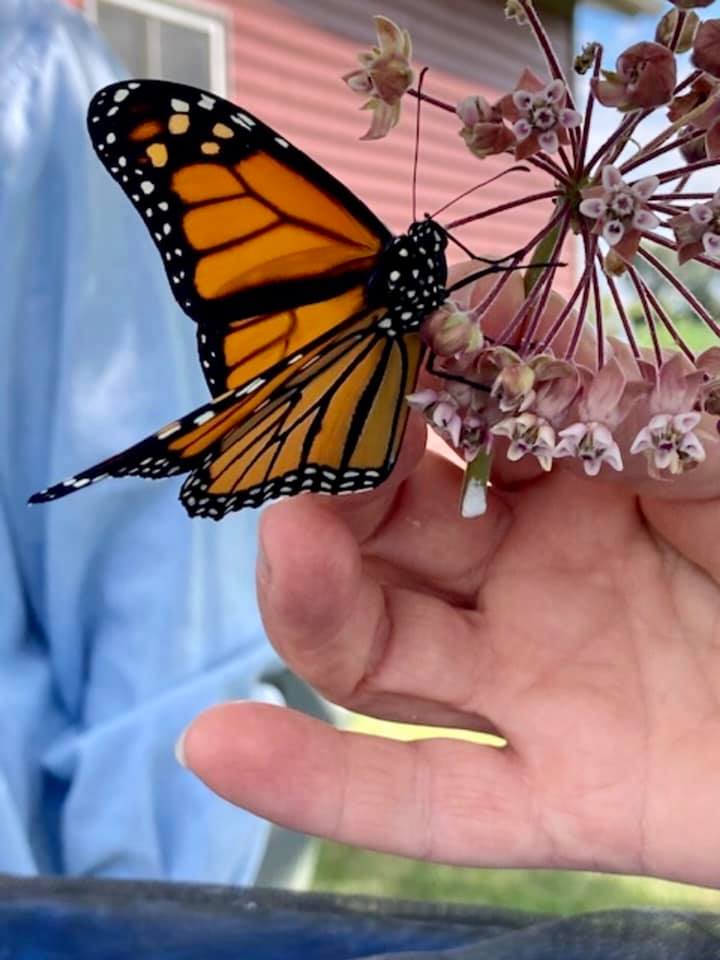
Before he took flight, the first glorious Monarch to emerge landed briefly on a milkweed blossom Kelly held in her hand. He paused for a few sips of nectar and a momentary fluttering of his wings in gratitude and affection…I think. Then knowing that he could…he flew away.

“Sweet freedom whispered in my ear, you’re a butterfly. And butterflies are free to fly. Fly away. High Away. Bye. Bye”

Bernie Taupin and Elton John, “Someone Saved My Life Tonight”
And Butterfly Are Free to Fly (Photo: Steve Forsgren)

A special thank you to my sister, Kelly Daab Green, for sharing her adventure with me and for allowing me to share it with you.